Understand the rules before they cost you.
Sourced account comparisons and plain-English guides for funded traders, alongside research models with their assumptions and results.
The state of the prop firm market
Median prices by account size, how firms measure drawdown, where profit splits sit, and which accounts buy the most buffer per dollar.
Prop trading glossary
20 rules and terms, explained in one sentence each.
- Activation fee
- Balance-based drawdown
- Buffer
- Consistency rule
- Daily loss limit
- EOD trailing drawdown
Read it once. Trade it better.
 Evaluation playbook
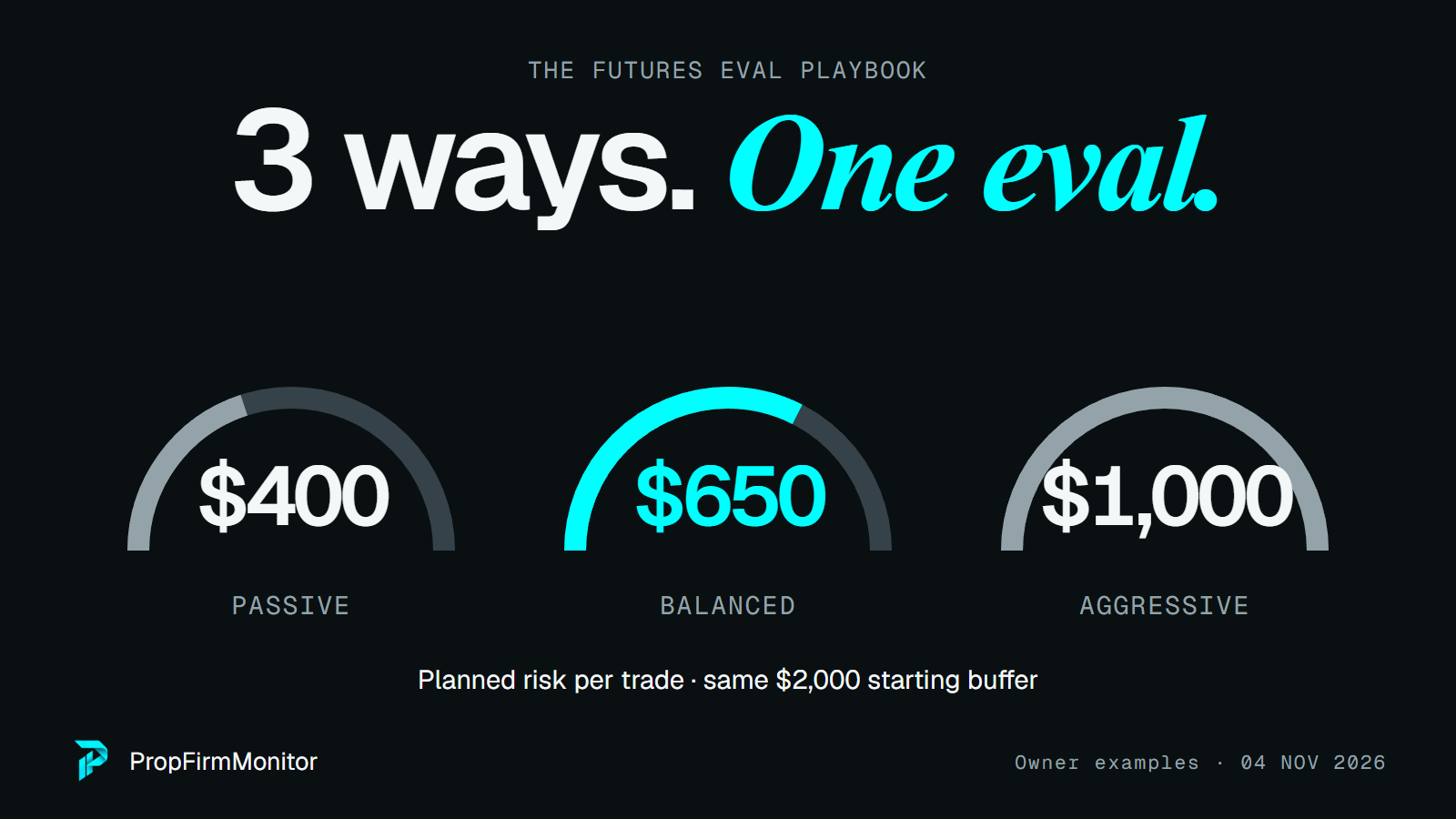
How to pass a $50K futures eval 3 ways, from careful to full send (playbook)
Compare $400, $650 and $1,000 planned risk across three real evaluations, with the balanced approach as my preferred starting point.
 Account size
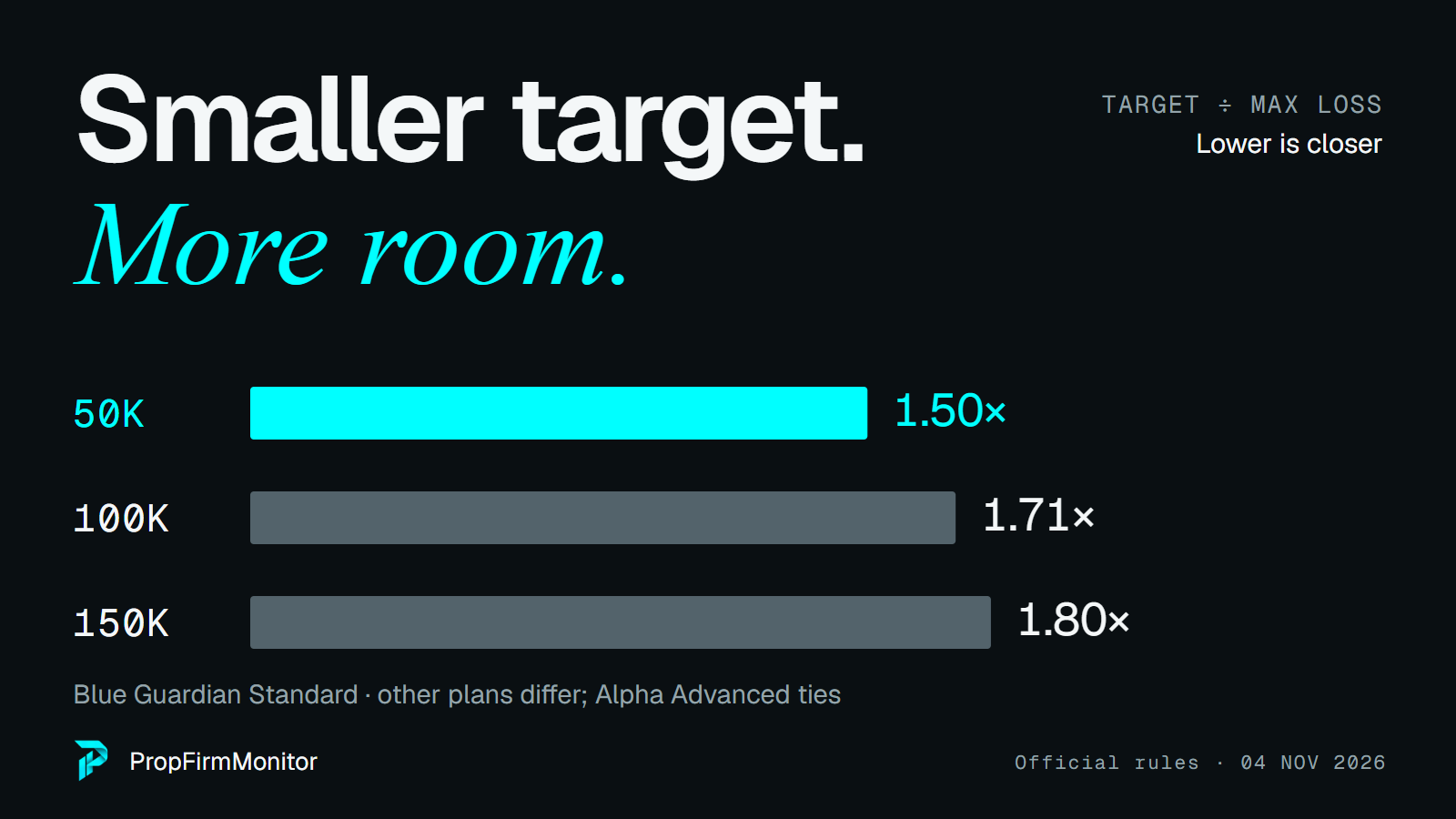
The $50K eval beats bigger sizes on target vs drawdown in 6 of 7 plans (exact ratios)
Six selected plans give $50K a lower target-to-loss ratio than their larger sizes. Alpha Advanced ties, so compare the plan before choosing the size.
 Consistency
A 40% consistency rule means you can't pass a $50K eval in 2 days (exact maths)
Work backwards from your best day. A 40% rule needs at least three profitable days, while a 50% rule allows two equal days before costs.
 Risk maths
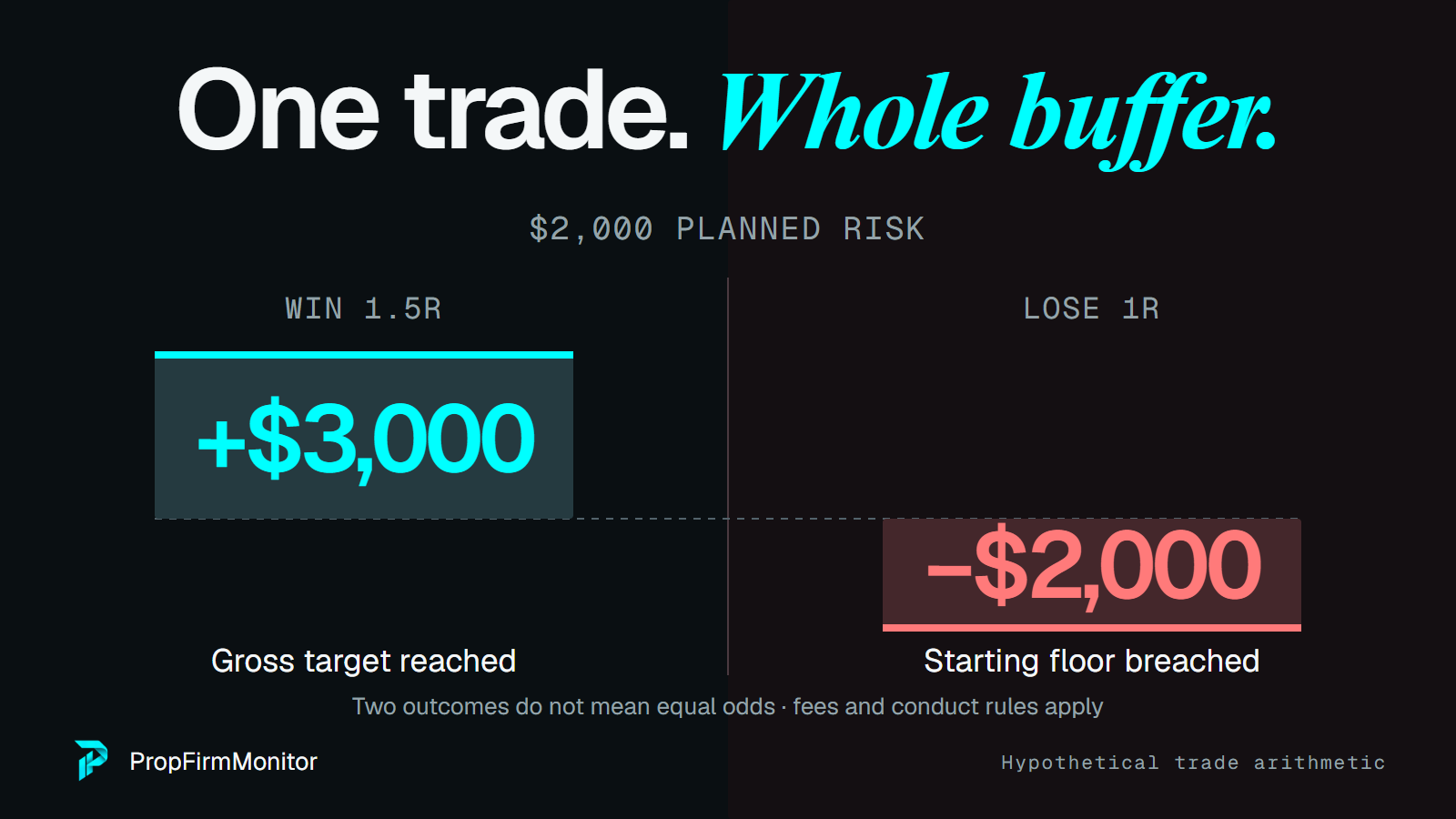
Risking the full $2,000 on one trade can pass or blow your eval in 1 day (full breakdown)
A $2,000 loss ends the fresh example. A 1.5R win reaches the $3,000 gross target, but fees, conduct rules and the moving floor still matter.
 The math of prop firms
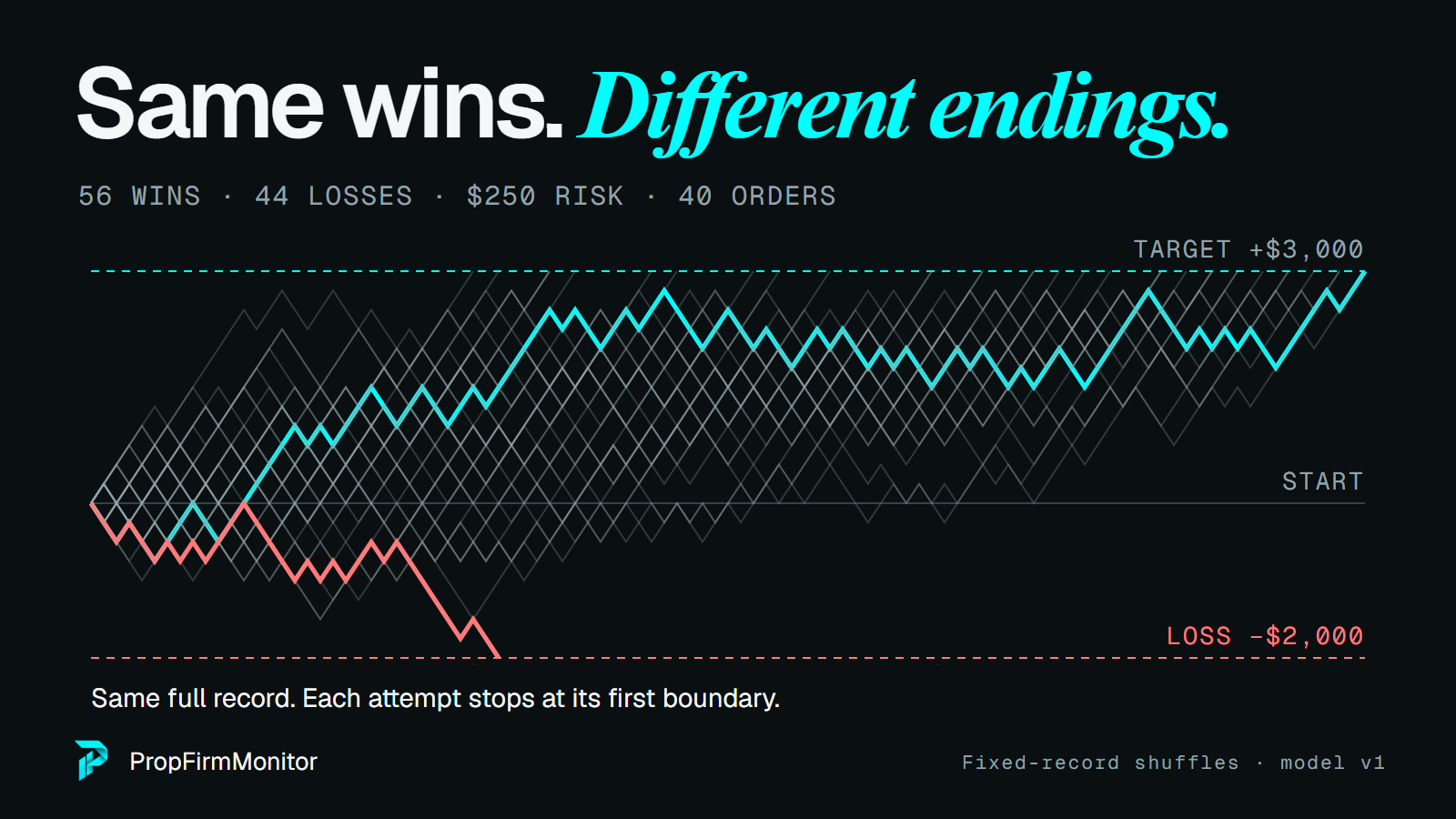
I ran one 56% strategy through 40 trade orders and got opposite results (walkthrough)
Forty orders of 56 wins and 44 losses end at the same hypothetical profit. Some hit the loss floor first and cannot use the later recovery.
 The math of prop firms
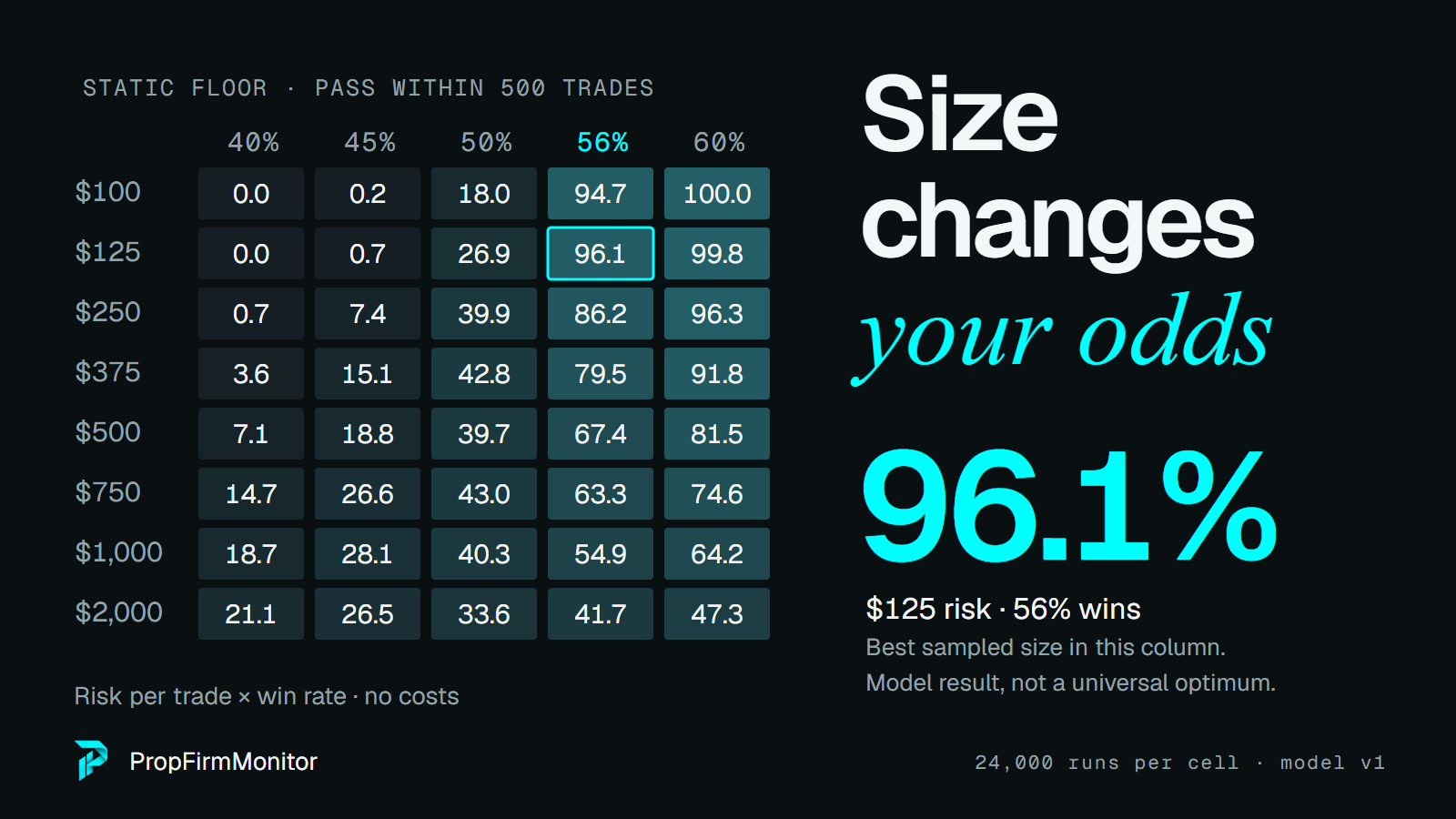
I tested 8 risk sizes on a $50K eval with the same 56% strategy (exact pass rates)
At 56% wins, $125 risk passes 96.1% of static-floor runs within 500 trades, versus 54.9% at $1,000. The trade budget and rule set decide the comparison.
 The math of prop firms
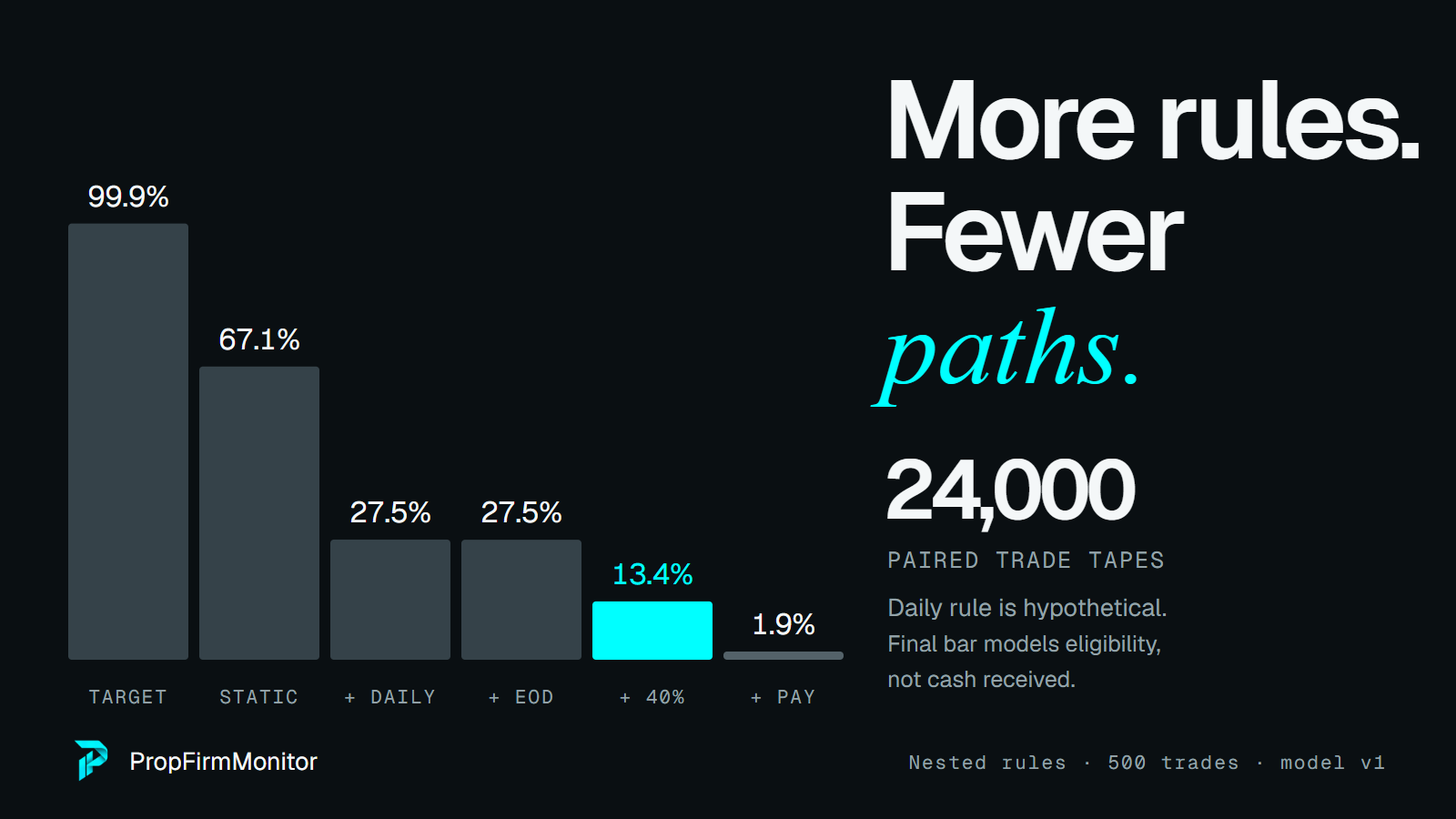
I tested 5 prop firm rules on one strategy and watched the pass rate fall (full breakdown)
Replay 24,000 paired trade tapes through a static floor, a hypothetical hard daily limit, EOD trailing and consistency, then a separate payout stage.
 The math of prop firms
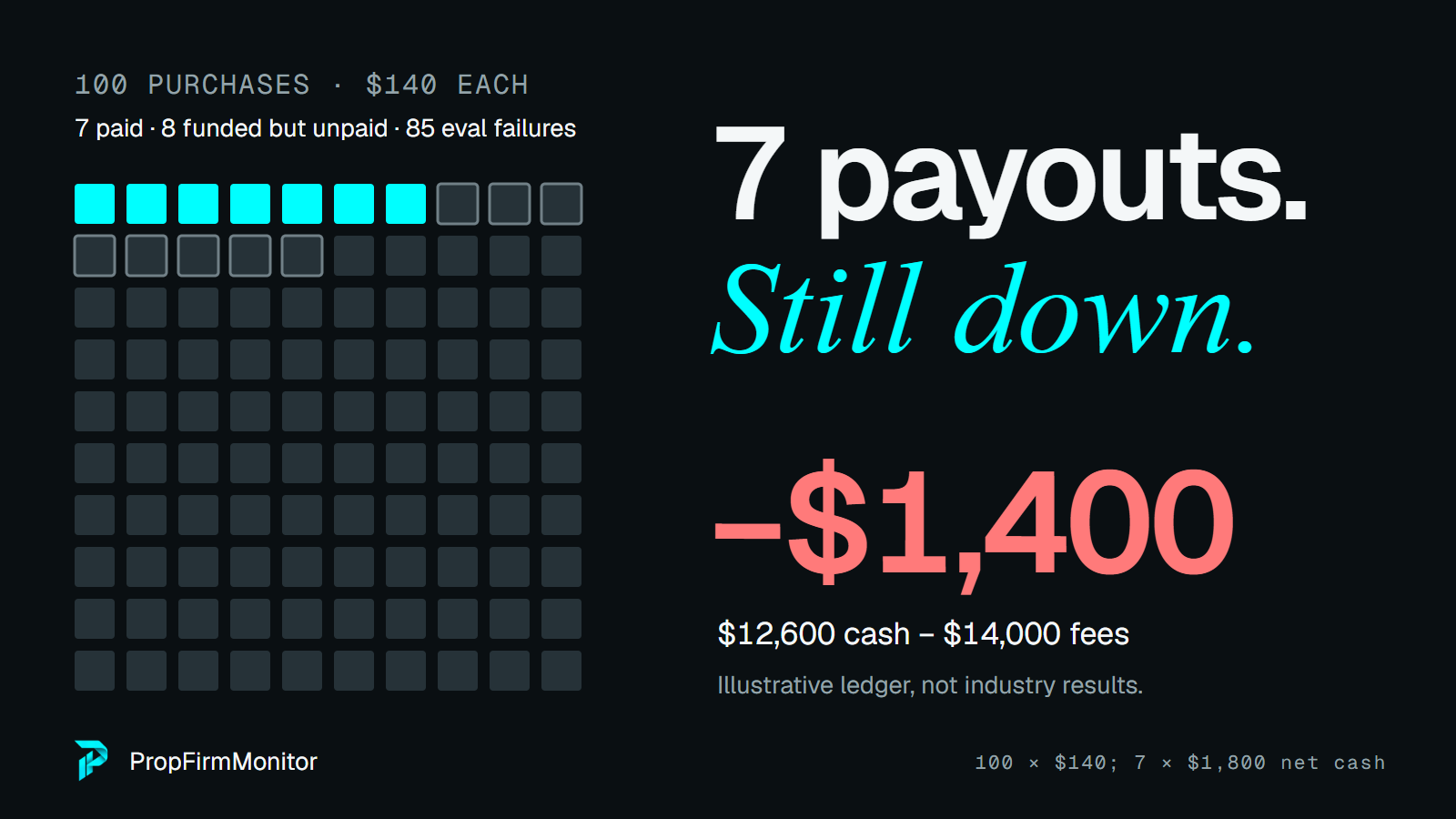
7 payouts on $14,000 of challenges and still down $1,400 (complete maths)
An illustrative ledger of 100 purchases at $140 and seven $1,800 payouts leaves a $1,400 loss. Count every attempt before calling a payout profit.
09Risk rulesEOD vs intraday trailing drawdown: what actually changes
Two accounts can show the same max loss and behave completely differently. The difference is when the floor moves.
10CostsThe true cost of a funded account
Sticker price is the smallest part of the bill. Activation fees, resets and billing models decide what you really pay.
11PayoutsConsistency rules, decoded
A consistency rule caps how much of your profit can come from a single day. Here is how to check it before you request a payout.
12EvaluationsOne-step, two-step or instant funding?
Each evaluation model trades price, time and pressure differently. Match the model to how you trade.
13CostsMonthly subscriptions vs one-time fees
Futures firms increasingly bill monthly. Here is when that is cheaper, and when it quietly is not.
14PayoutsHow to read a payout policy
Split, frequency, minimums, caps and buffers: the five numbers that decide when money actually reaches you.
